

.webp)
Pet Dental Care in Stroud & Stonehouse
Pet dental care is an essential part of their overall wellbeing. Our team provides thorough dental checks, preventative care and effective treatments to tackle issues early. From routine consultations to advanced procedures, we are here to support your pet’s comfort, health and happiness every step of the way.
Why is pet dental care important?
Regular dental checks, both at home and at the practice, are the best way to catch problems early and keep your pet’s mouth healthy throughout their life.
- It helps prevent painful conditions like periodontal disease.
- Looking after your pet’s teeth reduces the risk of tooth loss.
- Good dental care can help prevent bacteria from spreading to vital organs like the heart, liver or kidneys.
- It will help your pet eat comfortably and maintain a healthy weight.
- Improves their overall quality of life (with less pain, more energy and a better mood).
- Allows for early detection of other health problems during dental checks.
The good news is that dental disease is largely preventable and, even where problems have already developed, early treatment makes a significant difference to the outcome. Knowing what to look out for at home is a useful first step.
Signs of dental problems in pets
Dental problems in pets are more common than many owners realise. Because our pets are so good at hiding discomfort, the signs can be easy to miss. Here are some of the red flags to look out for:
- Bad breath (halitosis) that persists, rather than just post-meal odour.
- Pawing at the mouth or rubbing the face on surfaces.
- Dropping food while eating or showing reluctance to eat.
- Favouring one side of the mouth when chewing, or chewing differently to usual.
- Excessive drooling or red, swollen or bleeding gums.
- Visible tartar (yellow-brown deposits on the teeth) or loose, missing teeth.
- A change in mood or activity levels that is otherwise unexplained.
Not all pets will show obvious signs even when dental disease is well established. This is why a dental assessment as part of a routine consultation is so valuable.
What to expect during your pet’s dental consultation
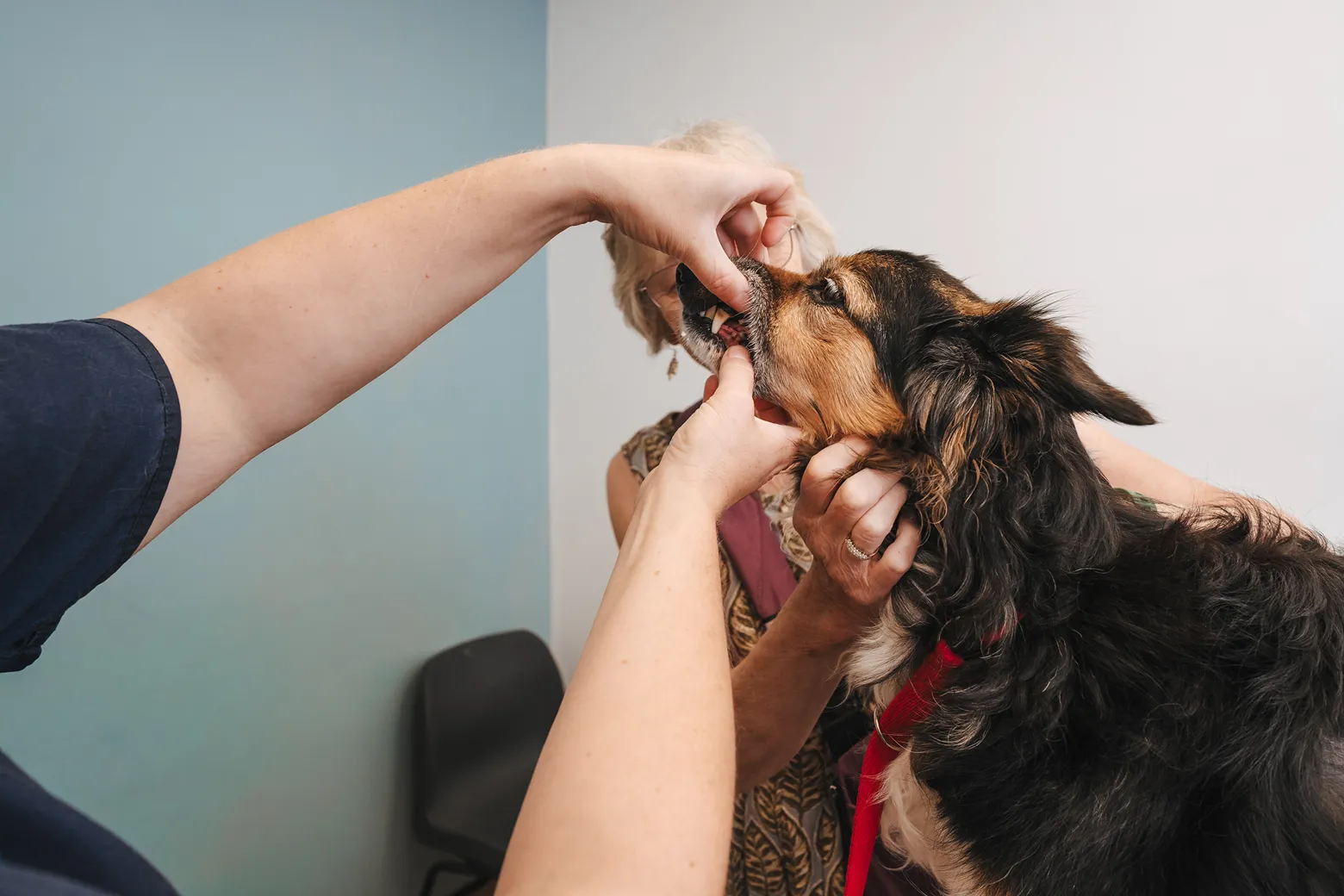
A routine dental consultation is a simple but important check of your pet’s oral health, designed to spot early signs of problems before they become serious. A dental consultation at Bowbridge Vets will include:
- A full oral examination to check your pet’s teeth, gums and overall mouth health.
- Assessment for signs of issues like gingivitis or early periodontal disease.
- Discussion of any symptoms you’ve noticed, like your pet having bad breath or changes in their eating habits.
- Advice on home dental care, including brushing techniques and dental products.
- A tailored recommendation on whether a professional clean is needed.
If further treatment is needed, this usually involves a professional dental procedure under anaesthetic to allow for a thorough clean and closer examination. Our team will guide you through every step and provide clear aftercare advice to support your pet’s recovery and ongoing dental health.
What does a pet dental procedure involve?
If your pet needs a dental procedure, it will be done under general anaesthesia. This is because a conscious pet cannot have their mouth properly examined and attempting to scale teeth on an animal that is awake would be unsafe for the vet and distressing for the pet. We understand that the word ‘anaesthetic’ is a source of worry for many owners and we take every precaution to minimise risk, including pre-anaesthetic blood tests where appropriate.
A standard procedure includes a full examination of all teeth and soft tissues, ultrasonic scaling to remove plaque and tartar, polishing to smooth the enamel surface and extraction of any teeth too damaged to save. Afterwards, we will walk you through exactly what was done, what we found and how to care for your pet’s teeth going forward.
We recommend pre-anaesthetic bloodwork, particularly for older pets, to check organ function before any procedure. We will discuss this with you at the time of booking.
Home dental care
The best way to slow the progression of dental disease is to build a home care routine. Daily tooth brushing with a pet-specific toothpaste is the gold standard. Human toothpastes must never be used on pets as they may contain artificial sweeteners that are toxic to dogs, or fluoride at concentrations not suitable for animals.
Getting a pet used to tooth brushing takes time and patience and starting young makes it significantly easier. Puppies and kittens can be introduced gradually, beginning with simply touching the gums and building up from there. We are happy to show you how to do this at any appointment.
Why choose Bowbridge Vets for your pet dental care?
Dental disease is one of those things that are easy to overlook, until they become problems. We would rather help you stay ahead of it. And, when treatment is needed, we’ll make sure it is handled properly, with your pet's comfort and safety at the centre of every decision.
- Clear, honest advice. We tell you what we find and what we recommend, without pressure or unnecessary procedures.
- Safe, thorough procedures. We take anaesthesia seriously and follow careful protocols to minimise risk. We do not cut corners because it is quicker.
- Support with home care. We can show you how to brush your pet's teeth, recommend products that genuinely help and work with you to build a routine you can stick to.
Good dental care is a long-term commitment and we are here to support it at every stage, from the first check to an annual clean to guidance on what to do at home in between.
Why Choose Bowbridge Vets?
Bowbridge Vets has been caring for the pets of Stroud and Stonehouse since 1967. Our team of RCVS-registered vets and Registered Veterinary Nurses brings decades of combined clinical experience to every appointment, from routine preventative care to complex primary care cases.
Most of our team have been with us for many decades, which means your pet is seen by people who know them, and who they know.
As an independent practice, we are not part of a corporate group. Every clinical decision is made by the vet in front of you, based entirely on what is right for your pet.
Our clients trust us with their pets year after year. That trust, built over more than half a century in this community, is something we work hard to preserve.
Frequently Asked Questions
Will my pet insurance cover my pet's dental care?
Only a few pet insurance policies cover dental treatment, and this often depends on the condition and whether it's considered preventable. Many insurers require evidence of regular dental check-ups and ongoing care. It's always best to check your individual policy or speak directly with your provider for clarification.
Is it too late to start brushing my pet's teeth?
It's never really too late to start, although older pets or those with existing dental issues may need a professional clean first to make brushing comfortable. With patience and the right approach, most pets can gradually get used to having their teeth brushed, improving their long-term oral health.
How often should my pet have a dental check?
As part of their annual health and vaccination appointment, we will always examine your pet's teeth. Depending on what we find, we may recommend a more detailed dental assessment or a cleaning procedure. Some pets, particularly small breeds and flat-faced breeds, are more prone to dental problems and may benefit from more frequent checks.
Is dental disease preventable?
Largely yes, though genetics play a role too. Some breeds are more prone to dental problems than others due to jaw structure and tooth alignment. Regular brushing is the most effective preventative measure available. Annual dental checks allow us to catch disease early, before it requires significant intervention. Starting home care early in a pet's life makes a genuine long-term difference.
Does my pet need anaesthetic for a dental procedure?
Yes. A proper dental examination cannot be performed on a conscious animal and scaling and polishing require precision and stillness that would be impossible to achieve safely otherwise. We take every precaution, including a pre-procedure health assessment, to reduce risk as far as possible.
My pet is elderly. Is anaesthetic too risky?
Age alone is no reason to avoid a necessary dental procedure. An elderly pet in dental pain is suffering and untreated dental disease can affect their overall health and quality of life. The risk of anaesthetic in older pets is managed through careful pre-procedure assessment, appropriate monitoring during the procedure and tailored protocols. We will be honest with you about the risk and work through the decision together.
What are the best things I can do to maintain my pet's dental health?
Regular brushing is the most effective way to keep your pet's teeth healthy. Ideally, we recommend this is done daily, or at least a few times a week. You can also use dental chews, toys and specially formulated diets to help reduce plaque build-up. Routine veterinary check-ups are essential to catch early signs of issues like gingivitis before they progress.
Can I clean my pet's teeth at home instead of having a scale and polish?
Home care is genuinely valuable and we strongly encourage it, but it cannot reverse established tartar or treat gum disease that has already set in. Once tartar has hardened on the tooth surface, it cannot be removed by brushing alone. At that point, a professional clean under anaesthetic is the only way to restore a clean baseline. After a procedure, home care helps maintain the result for as long as possible.
My cat is not eating as much as normal and seems uncomfortable. Could this be dental pain?
It is certainly possible. Dental pain is a common but often invisible reason why cats reduce their food intake or show reluctance to eat. Cats are exceptionally good at masking discomfort, so by the time a change in eating is noticeable, there may already be significant dental disease present. We would recommend booking an appointment sooner rather than later so we can have a look.