

.webp)
Orthopaedic Surgery for Pets in Stroud & Stonehouse
Orthopaedic problems can come on suddenly or creep in gradually. A dog that’s reluctant to put weight on a leg, a cat that’s stopped jumping up onto its favourite spot, a pet that’s clearly uncomfortable but struggling to tell you exactly why. These are the signs that something may be going on with their bones or joints.
What Is Orthopaedic Surgery?
Orthopaedic surgery treats bones, joints, ligaments and tendons. Its goal is to restore the comfort and function that pain or instability has taken away. The range of conditions it covers is broad, from fractures requiring immediate stabilisation to joint problems that have developed slowly over time.
A thorough clinical examination and, in most cases, X-rays come before any surgical recommendation. We look at the full picture first.
Conditions We Treat
Cruciate ligament disease
Cruciate ligament disease is the most common orthopaedic condition we see in dogs. Cruciate ligaments stabilise the knee joint. When this degenerates or ruptures, the joint becomes unstable and painful. Some dogs show sudden, severe lameness; others show a more gradual deterioration over weeks or months.
Cruciate disease tends to be degenerative rather than the result of a single dramatic injury, which is why some breeds are more prone to it than others. Once diagnosed, surgical stabilisation is usually recommended to restore comfort and prevent further joint damage.
We’ll discuss the appropriate technique for your dog based on their size, breed and overall condition.
Luxating patella
A luxating patella is a kneecap that slips out of its normal groove. It’s particularly common in smaller dog breeds. In mild cases it causes an occasional skipping gait; in more severe cases it leads to persistent lameness and discomfort.
Where the condition is causing significant problems, surgical correction can restore normal kneecap positioning and dramatically improve quality of life. We’ll assess the situation before making any recommendation and talk through whether surgery is the right course of action for your dog specifically.
Fracture repair
Fractured bones in dogs and cats most commonly result from road traffic accidents, falls from height or other traumatic injuries. Fracture management depends on several factors: which bone is affected and the nature and position of the break, as well as the age, size and overall health of the patient.
Whatever the situation, we’ll explain the options and costs clearly and help you understand which path is most likely to give your pet the best outcome.
Joint conditions and osteoarthritis
Not all joint problems need surgery. Osteoarthritis, the gradual deterioration of joint cartilage over time, is very common in older dogs and cats and is typically managed through a combination of pain relief, controlled exercise and lifestyle adjustments. In some cases, surgical intervention can help address an underlying structural problem and slow further deterioration.
If your pet is showing signs of stiffness, reluctance to exercise or difficulty getting up and down, a consultation is a sensible starting point. We’ll assess what’s going on and advise on whether medical management, surgery or a combination of the two is most appropriate.
Diagnosis Comes First
We don’t make surgical recommendations based on a hunch. Before any decision is made, we carry out a thorough physical examination, including specific orthopaedic tests for the relevant joints and limbs. In some cases we take X-rays to see clearly what’s happening to the bone and joint structures.
This diagnostic stage can be really helpful. It confirms what’s going on, rules out other causes and means that any recommendation we make is grounded in a clear picture of your pet’s individual situation.
Our Surgical Approach
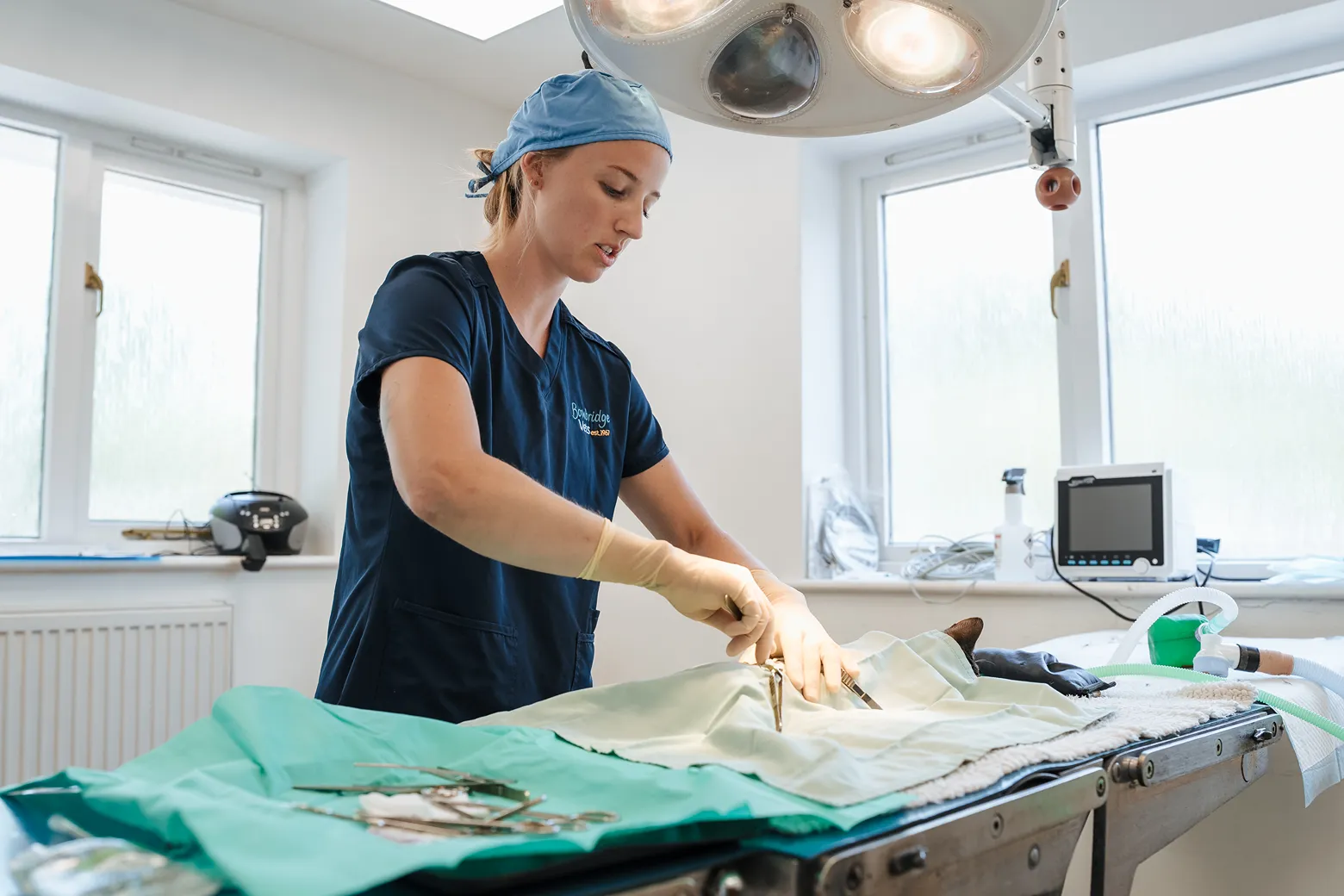
As with all surgery at Bowbridge Vets, orthopaedic procedures are carried out under general anaesthetic with a dedicated veterinary nurse monitoring your pet throughout.
Pre-operative discussion and consent
Before any procedure is booked, we’ll talk you through what we’re recommending, what the surgery involves, what recovery looks like and what it’s going to cost.
Consent forms are explained rather than just handed over, you’ll have the opportunity to ask questions and take time to decide.
Pre-anaesthetic health assessment
Every orthopaedic patient receives a clinical examination before any anaesthetic is given. For older patients or those with existing health conditions, we recommend pre-anaesthetic blood tests to check kidney and liver function. These are the organs that process anaesthetics. Knowing how they’re performing helps us tailor the anaesthetic protocol to your pet.
Anaesthesia and monitoring
A veterinary nurse monitors every patient continuously throughout their procedure, tracking heart rate, respiratory rate, blood pressure, body temperature and oxygen levels. We take anaesthetic safety seriously and follow careful protocols at every stage.
Pain management
Orthopaedic procedures involve bone and joint structures. Pain management is a priority from the start. It begins before surgery, continues throughout the procedure and is maintained into recovery. You and your pet will go home with analgesia and clear instructions on how to use it. We’ll also explain what’s normal in terms of post-operative discomfort and when to contact us.
Recovery and post-operative care
Orthopaedic recovery takes longer than soft tissue recovery, it’s important to follow the aftercare plan carefully. For conditions like cruciate ligament repair, the initial recovery period typically involves strict rest and gentle exercise for several weeks, followed by a gradual and structured return to normal activity.
We’ll provide written aftercare instructions tailored to your pet’s specific procedure and schedule follow-up appointments to monitor progress. Physiotherapy or hydrotherapy can be genuinely beneficial after some orthopaedic procedures, particularly for cruciate repair. We’ll advise at discharge if that’s something worth considering for your pet.
When to Seek Urgent Help
Some orthopaedic problems require prompt attention. If you notice any of the following, contact us as soon as possible:
- Sudden inability to bear weight on a limb
- An obvious injury following a road traffic accident or a fall from height
- Severe or rapidly worsening swelling around a joint or limb
- A limb that appears visibly out of its normal position
Our registered patients have access to emergency cover, either at our practice during opening hours, or at the emergency out-of-hours service at Wood Veterinary Hospital.
Why Choose Bowbridge Vets For Surgery?
Thinking about surgery for your pet is never easy. What we can offer is a straightforward approach and a team that takes the time to explain things properly.
Every surgical patient at Bowbridge Vets receives a full pre-operative assessment before anything proceeds. A dedicated veterinary nurse monitors every patient throughout their procedure. And, when you collect your pet, you leave with clear aftercare instructions and the confidence that we’re here if questions come up during recovery.
We’re an independent practice. That matters to us, because it means clinical decisions are made by the vet in front of you, based on your pet’s needs alone. When referral to a specialist is in your pet’s best interest, we will say so clearly and help you get there.
Frequently Asked Questions
My pet is suddenly lame. Does it need orthopaedic surgery?
Not necessarily. Lameness can have a range of causes, some orthopaedic and some not. A thorough examination is always the starting point. We'll assess which limb is affected, how severely and what the most likely cause is. In some cases, imaging is necessary to get a clear picture. Surgery is only one of several possible outcomes; we won't recommend it unless the evidence points that way.
How long does recovery from orthopaedic surgery take?
It depends on the procedure and the patient, but orthopaedic recovery generally takes longer than recovery from soft tissue surgery. Cruciate ligament repair, for example, typically involves several weeks of restricted exercise followed by a gradual return to normal activity over a number of further weeks.
Fracture repair recovery depends on the bone involved and the technique used. We'll give you a realistic timeline for your pet's specific procedure and a clear plan to follow at home.
Is orthopaedic surgery painful for my pet?
Your pet won't feel anything during the procedure itself. We use appropriate anaesthesia and analgesia throughout, then the pain management continues into the recovery period. Some post-operative discomfort is normal and expected.
We'll send you home with pain relief and instructions on how to use it. Most pets are more comfortable within a few days, though full recovery from some procedures takes considerably longer.
My pet is elderly. Is surgery too risky?
Age alone is no reason to avoid surgery when it's genuinely needed. An older pet living with orthopaedic pain is suffering and that suffering affects their quality of life every day. What matters is a careful pre-operative assessment to understand the situation.
We'll go through the risks and benefits with you openly and work through the decision together. We won't push you towards surgery if we don't think it's the right call.
Do you refer pets to specialist orthopaedic surgeons?
When it's appropriate. Some cases, particularly complex fractures or certain procedures in larger breeds, are better treated by a specialist. We'll tell you when that's our view and help with the referral process. Our priority is the best outcome for your pet.
Will my pet need physiotherapy after orthopaedic surgery?
Physiotherapy or hydrotherapy can be genuinely beneficial after orthopaedic procedures, particularly for cruciate ligament repair. It helps rebuild muscle strength, improves range of movement and supports fuller recovery. We'll advise at discharge whether this is something we'd recommend for your pet.